Growing Past 10 Rentals: Portfolio and Blanket Loans vs One Loan per Door
How serious investors keep financing after conventional lenders cap them out, and how to choose between a DSCR loan on each property and one blanket loan across many.

Short answer
Conventional guidelines generally cap investors at 10 financed properties. Past that, investors either take a DSCR loan on each property, which qualifies on each property's own rent, or one blanket loan across several properties: simpler to manage, but harder to unwind when you sell.
Key points
- Agency guidelines generally stop at 10 financed properties.
- DSCR loans have no personal-income ceiling.
- Blanket loans trade flexibility for simplicity.
Why the 10-property wall exists
Conventional mortgages sold to Fannie Mae and Freddie Mac follow agency rules, and those rules generally cap a borrower at 10 financed properties, with tougher credit and reserve requirements as you approach the limit. Each new loan also adds to your debt-to-income ratio, which counts against you even when the rentals pay for themselves.
For a growing investor, that means the financing that got you started can stop working right when the business is gaining momentum.
Path one: a DSCR loan on each property
With DSCR financing, each property is underwritten on its own rent against its own payment; see DSCR loans, explained. Your personal income isn't the gate, so there's no built-in ceiling on how many properties you hold, though individual lenders set their own exposure limits.
Why investors like it: each property stands alone. You can sell, refinance or restructure one without touching the others, and pick the best terms for each deal.
The trade-off: more closings, more statements and more due dates to manage as the portfolio grows.
Path two: one blanket or portfolio loan
A blanket loan finances several properties under a single note, secured by all of them.
Why investors like it: one closing, one payment and one maturity date to manage. A strong property can also help carry a weaker one inside the same loan.
The trade-off: the properties are tied together. Selling one usually requires a release clause, which often means paying down more than that property's share of the loan. And trouble at one property can put the whole loan at risk.
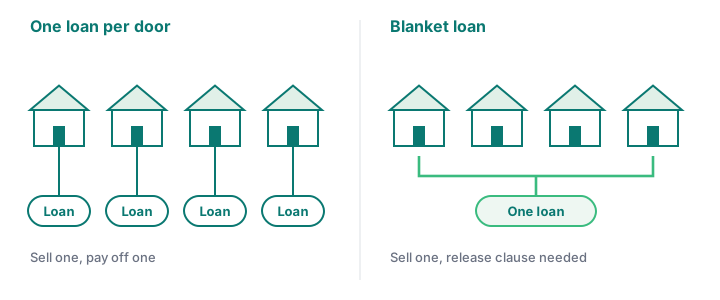
One loan per door keeps every property independent; a blanket loan ties several properties to one note.
Blanket loan vs one loan per door
| One DSCR loan per property | Blanket or portfolio loan | |
|---|---|---|
| Underwritten on | Each property's rent | The combined portfolio |
| Closings | One per property | One for the group |
| Selling one property | Pay off just that loan | Needs a release clause |
| If one property struggles | Only that loan is affected | The whole loan is exposed |
| Paperwork over time | More loans to track | One loan to manage |
| Best for | Investors who buy, sell and refinance often | Stable, long-term holds bought or refinanced together |
Many investors end up using both: individual DSCR loans while they're actively trading, then a portfolio loan once a group of properties is stabilized for the long haul.
Already near or past 10 properties? Send your rent roll and we'll show you both structures. Review my portfolio
Get your portfolio lender-ready
Whichever path you choose, a growing portfolio earns better terms when it's easy to underwrite:
- Keep a current rent roll: address, unit, lease start, rent and deposit.
- Hold leases, insurance declarations and tax bills in one place for each property.
- Keep entity documents current: operating agreement, EIN letter and good standing.
- Track each property's payment so you know every DSCR before a lender asks.
- Grow reserves along with the portfolio; lenders look for liquidity as you scale.
Pulling equity to fund the next purchase? See cash-out refinancing on a rental.
Frequently asked questions
How many mortgages can a real estate investor have?
Conventional (agency) guidelines generally cap a borrower at 10 financed properties. DSCR loans don't rely on your personal income, so there's no built-in cap, though each lender sets its own exposure limits.
What is a blanket loan?
A blanket loan finances several properties under one note, secured by all of them. You get one closing and one payment, but the properties are tied together.
What is a release clause?
A release clause lets you sell or refinance one property out of a blanket loan by paying down a set amount, often more than that property's share of the balance.
Should I use a blanket loan or individual DSCR loans?
Individual loans suit investors who buy, sell and refinance often. A blanket loan suits stable, long-term holds you'd buy or refinance together. Many investors use both at different stages.
Get KREC insights first in Google Search.
Add KREC as a preferred source on GoogleRelated Articles
Hard money loans offer fast, flexible financing for real estate investors. Learn how they work, when to use them, and what to expect.
Everything you need to know about fix and flip financing, from loan terms to maximizing your profits on renovation projects.
How DSCR loans qualify a rental on its rent instead of your income: the formula, a worked example, what lenders check and a five-minute self-test.
Ready to Apply What You've Learned?
Get pre-approved for your next investment property. Fast closings, flexible terms.
Get Started Today