DSCR Loans, Explained: Qualify on the Rent, Not Your Tax Return
How debt service coverage ratio loans work, what lenders check besides the rent, and a five-minute test to see whether your next rental qualifies.
Short answer
A DSCR loan qualifies an investment property on its rental income instead of your personal income. The lender divides the monthly market rent by the monthly payment (principal, interest, taxes, insurance and any HOA). At 1.0 the rent covers the payment, and many programs look for 1.0 to 1.25.
Key points
- Your W-2s and tax returns usually stay out of it.
- The core math is rent divided by the full monthly payment.
- Credit, down payment and reserves still have to fit the program.
Why investors use DSCR loans
Conventional mortgages qualify you. They want your income, your tax returns and your debt-to-income ratio, and every rental you add makes that math harder. Self-employed investors feel it most: the write-offs that lower your taxes also shrink the income a bank will count.
A DSCR loan flips the question. Instead of asking whether you can afford the property, it asks whether the property pays for itself. If the rent covers the payment, the loan can work, whether it's your first rental or your fifteenth.
How to calculate DSCR
DSCR = monthly rent ÷ monthly PITIA
PITIA is principal, interest, taxes, insurance and any HOA dues. A ratio of 1.00 means the rent exactly covers the payment; 1.25 means the rent runs 25% above it. Here's a typical single-family rental.
Deal sheet: Single-family rental, illustrative
| Amount | |
|---|---|
| Purchase price | $350,000 |
| Down payment, 25% | $87,500 |
| Loan amount | $262,500 |
| Principal and interest, 7.50% 30-year | $1,835 |
| Property taxes | $310 |
| Insurance | $140 |
| Total monthly payment (PITIA) | $2,285 |
| Market rent | $2,800 |
| DSCR | 1.23 |
At 1.23, this property clears the bar for many DSCR programs. If the rent were $2,285, the ratio would fall to 1.00; reaching 1.25 takes about $2,857 a month.
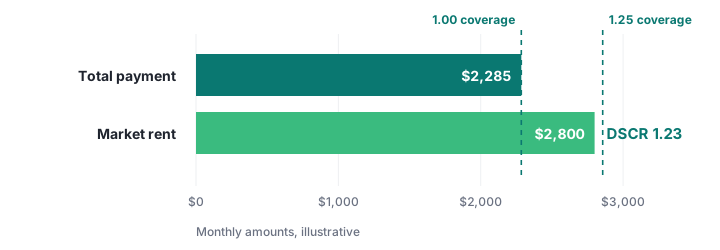
Rent against the full monthly payment. At $2,800, the rent covers the payment 1.23 times; reaching 1.25 would take about $2,857 a month.
DSCR loan requirements beyond the ratio
The ratio opens the door, but it isn't the whole file. Expect a DSCR lender to review:
- Credit score. Minimums vary by program, and higher scores usually earn better pricing.
- Down payment. Purchases commonly need 20 to 25% down; the exact figure moves with credit, ratio and property type.
- Reserves. Lenders often want several months of payments in the bank after closing.
- The property. Its condition, its type (single-family, condo, 2 to 4 units) and whether it's rent-ready.
- How you hold title. Many investors close in an LLC, so expect a request for the entity documents.
Have a property in mind? Send the address and rent, and a KREC loan advisor will run the DSCR for you. Check my DSCR
Where the rent number comes from
The lender usually doesn't take your word for the rent. The appraiser completes a rent schedule (Form 1007 for a single-family home, or the rental section of Form 1025 for 2 to 4 units) based on comparable rentals. If the property is already leased, many lenders use the lower of the lease and the appraiser's market rent.
Short-term rentals are their own category. Some programs accept booking history or third-party revenue projections; others don't. Ask before you buy.
When a DSCR loan isn't the right fit
DSCR loans are business-purpose loans for investment property, so they don't work for a home you'll live in. And if you have strong, documented W-2 income and only a few financed properties, a conventional loan may price better. The rate matters too: see what half a point does to your DSCR.
Your five-minute DSCR self-test
- Pull the likely market rent from three comparable rentals nearby.
- Estimate taxes and insurance from the listing or a quick quote.
- Get a payment estimate at your planned down payment.
- Divide the rent by the total payment.
- At 1.0 or better you're in range. Below 1.0, look at a larger down payment, a lower rate or an interest-only option.
Already own rentals with equity? A cash-out refinance can fund your next down payment.
Frequently asked questions
What is a good DSCR for a rental property loan?
Many DSCR programs look for a ratio between 1.0 and 1.25, meaning the rent covers the full payment or exceeds it by up to 25%. Some programs go below 1.0 with a larger down payment or stronger credit, usually at higher pricing.
Do DSCR loans require tax returns or W-2s?
Usually not. DSCR loans qualify the property on its rent, so most programs don't use your personal income. Expect a credit check, bank statements for the down payment and reserves, and documents on the property and any LLC.
Can I get a DSCR loan in an LLC?
Yes. Many investors close DSCR loans in an LLC. The lender will ask for the entity's formation documents, operating agreement and EIN, and usually a personal guarantee.
How does the lender decide what the rent is?
The appraiser estimates market rent from comparable rentals on a rent schedule. If the property is already leased, many lenders use the lower of the lease and the market rent.
Can I use a DSCR loan on a home I'll live in?
No. DSCR loans are business-purpose loans for investment property only. A home you'll live in needs a consumer mortgage.
Get KREC insights first in Google Search.
Add KREC as a preferred source on GoogleRelated Articles
Hard money loans offer fast, flexible financing for real estate investors. Learn how they work, when to use them, and what to expect.
Everything you need to know about fix and flip financing, from loan terms to maximizing your profits on renovation projects.
Bridge loans provide quick capital when you need to act fast. Learn when bridge financing makes sense for your real estate deals.
Ready to Apply What You've Learned?
Get pre-approved for your next investment property. Fast closings, flexible terms.
Get Started Today