What Half a Point Actually Does to Your Payment (and Your DSCR)
Half a point sounds small. Here's exactly what it does to a monthly payment, to your cash flow and to the DSCR a lender sees, plus how to tell whether buying the rate down pays back.
Short answer
On a 30-year loan, half a point changes the payment by roughly $34 a month for every $100,000 borrowed: about $136 a month on $400,000. For a rental, that can move the DSCR across 1.0. Buying the rate down only pays if you keep the loan past the break-even point.
Key points
- About $1,600 a year on a $400,000 loan.
- Enough to move a rental's DSCR across 1.0.
- Points pay back only past the break-even month.
Half a point, in dollars
Monthly principal and interest on a 30-year loan at 7.50% versus 7.00%:
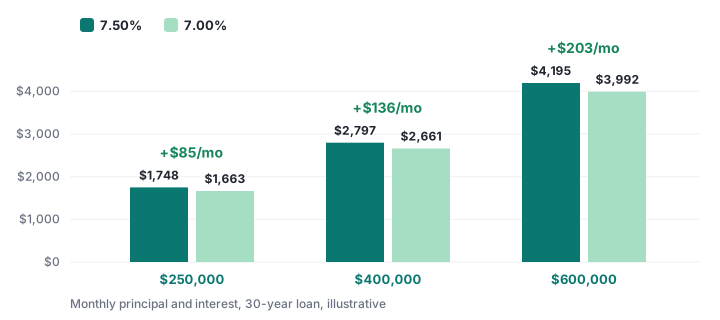
Monthly principal and interest on a 30-year loan at 7.50% and 7.00%. The gap grows with the loan: about $34 a month per $100,000.
| Loan amount | At 7.50% | At 7.00% | Monthly difference | Yearly difference |
|---|---|---|---|---|
| $250,000 | $1,748 | $1,663 | $85 | $1,017 |
| $400,000 | $2,797 | $2,661 | $136 | $1,628 |
| $600,000 | $4,195 | $3,992 | $203 | $2,442 |
Half a point, in DSCR
For an investor, the payment isn't just a budget line; it decides whether a rental loan qualifies. Take a $400,000 DSCR loan on a property that rents for $3,250 a month, with $375 in taxes and $150 in insurance.
Deal sheet: $400,000 DSCR loan, $3,250 rent, illustrative
| At 7.50% | At 7.00% | |
|---|---|---|
| Principal and interest | $2,797 | $2,661 |
| Taxes and insurance | $525 | $525 |
| Total payment (PITIA) | $3,322 | $3,186 |
| DSCR at $3,250 rent | 0.98 | 1.02 |
Same house, same rent. At 7.50% the rent doesn't quite cover the payment; at 7.00% it does. Many DSCR programs treat 1.0 as a key line, so half a point can change which programs fit, the pricing you get or how much you need to put down. More on the ratio in DSCR loans, explained.
Buying the rate down: does it pay?
Paying points, upfront fees each equal to 1% of the loan, can lower your rate. How much a point buys varies with the market and the program, so treat this as an example of the math, not a quote.
Say one point, $4,000 on a $400,000 loan, takes the rate from 7.50% to 7.25%. The payment drops from $2,797 to $2,729, a saving of $68 a month.
Break-even = $4,000 in points ÷ $68 saved a month ≈ 59 months
If you'll hold the loan for more than about five years, the buydown pays. If you plan to sell or refinance sooner, it probably won't, and on a DSCR loan a prepayment penalty can make an early refinance cost more still.
Want this math on your own deal? Send the loan amount and rent and we'll run it. Run my numbers
Should you wait for rates to fall?
Nobody can time rates reliably, so frame the decision around your deal instead:
- Does the deal work today? If it cash-flows at today's rate, a lower rate later is a bonus you can refinance into.
- What does waiting cost? Rent you don't collect, and prices that may move while you wait.
- What would refinancing cost? Closing costs plus any prepayment penalty on the loan you'd replace; see cash-out and rate-and-term refinancing.
A deal that only works if rates fall is one to pass on. A deal that works today and gets better if rates fall is one to look at seriously.
Frequently asked questions
How much does half a percent change a mortgage payment?
On a 30-year amortizing loan at around 7%, about $34 a month for every $100,000 borrowed. On a $400,000 loan, that's roughly $136 a month, or $1,600 a year.
Is it worth paying points on an investment property loan?
Only if you'll keep the loan past the break-even point. Divide the cost of the points by the monthly saving; if you'll hold the loan longer than that, the buydown pays.
How does the interest rate affect DSCR?
A higher rate raises the payment, which lowers the DSCR. On a $400,000 loan renting for $3,250, moving from 7.00% to 7.50% takes the ratio from 1.02 to 0.98.
Should I wait for rates to fall before buying a rental?
Judge the deal at today's rate. If it works now, a lower rate later is a bonus you can refinance into, less closing costs and any prepayment penalty. If it only works at a lower rate, pass.
Get KREC insights first in Google Search.
Add KREC as a preferred source on GoogleRelated Articles
Hard money loans offer fast, flexible financing for real estate investors. Learn how they work, when to use them, and what to expect.
Everything you need to know about fix and flip financing, from loan terms to maximizing your profits on renovation projects.
How DSCR loans qualify a rental on its rent instead of your income: the formula, a worked example, what lenders check and a five-minute self-test.
Ready to Apply What You've Learned?
Get pre-approved for your next investment property. Fast closings, flexible terms.
Get Started Today