Cash-Out Refinance on a Rental: Pulling Equity to Fund the Next Deal
How to turn the equity in a rental into cash for your next purchase, what lenders look for, how long you may need to wait, and a worked BRRRR example.

Short answer
A cash-out refinance replaces the loan on a rental with a larger one sized on today's appraised value and pays you the difference. On rentals, lenders commonly cap cash-out loans around 70 to 75% of value, often require a minimum ownership period first, and still need the rent to cover the new payment.
Key points
- The appraisal sizes everything, so prepare for it.
- Many lenders want 3 to 12 months of ownership first.
- The rent still has to cover the bigger payment.
How a cash-out refinance works
You take a new loan against the property, sized on today's appraised value. It pays off any existing debt and the closing costs, and the rest comes to you. On a rental, that cash can become the down payment on the next property while the house keeps producing rent.
For investors, the new loan is often a DSCR loan, so it qualifies on the property's rent rather than your personal income; see DSCR loans, explained. The new payment still has to work: the rent needs to cover it at the ratio the lender requires.
The numbers that decide your cash-out
Appraised value. Everything is sized from it, so the appraisal is the event to prepare for.
Maximum loan-to-value. Cash-out limits usually sit below purchase limits. Many lenders land around 70 to 75% for rentals, varying with credit, property type and the ratio.
DSCR on the new payment. A bigger loan means a bigger payment, and it still has to clear the lender's coverage ratio.
Seasoning. Many lenders require a minimum ownership period, often somewhere between 3 and 12 months, before they'll use the new appraised value. Before then, some cap the loan at your purchase price plus documented rehab costs.
A BRRRR refinance example
An investor buys a house for $200,000 cash and puts $50,000 into the rehab. Once finished, it rents for $2,700 a month and appraises at $340,000.
Deal sheet: BRRRR refinance, illustrative
| At 75% LTV | At 70% LTV | |
|---|---|---|
| Appraised value | $340,000 | $340,000 |
| New loan | $255,000 | $238,000 |
| Estimated closing costs | $7,000 | $7,000 |
| Cash back | $248,000 | $231,000 |
| Share of the $250,000 invested | 99% | 92% |
| New payment, 7.50% 30-year, with $400 taxes and insurance | $2,183 | $2,064 |
| DSCR at $2,700 rent | 1.24 | 1.31 |
At 75%, the investor recovers almost every dollar and still owns a rental that covers its payment with room to spare. That recovered cash funds the next deal, which is the whole point of buy, rehab, rent, refinance, repeat.
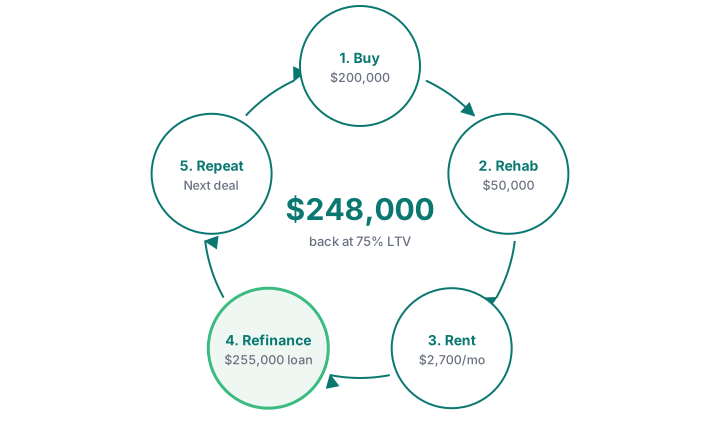
The BRRRR cycle on this deal: $250,000 in, $248,000 back at 75% LTV, and a rental that still covers its payment 1.24 times.
Before you apply
- Document the rehab. Invoices, photos and permits support both the appraisal and any cost-based limit.
- Get it rented. A signed lease at market rent makes the DSCR math and the appraisal easier.
- Know your current loan's terms. Check for a prepayment penalty on the debt you're paying off.
- Check the clock. Count the months since purchase against the lender's seasoning rule.
- Run the payment first. Make sure the new payment still leaves the cash flow you want.
Finished a rehab recently? Send what you paid and what you put in, and we'll estimate your cash-out. Estimate my cash-out
When rate-and-term beats cash-out
If you don't need the cash, a rate-and-term refinance with no cash out can bring better pricing and a lower payment. Pull cash when you have a specific use for it, like the next down payment, not just because the equity is there. Coming off a flip? Start with how fix-and-flip loans are structured.
Frequently asked questions
How much cash can I take out of a rental property?
Many lenders cap cash-out refinances on rentals at roughly 70 to 75% of the appraised value, minus your existing loan and closing costs. The rent also has to cover the new, larger payment.
How long do I have to own a property before a cash-out refinance?
Many lenders want somewhere between 3 and 12 months of ownership before they'll use the new appraised value. Before that, some cap the loan at your purchase price plus documented rehab costs.
Can I do a cash-out refinance with a DSCR loan?
Yes. A DSCR cash-out refinance qualifies on the property's rent rather than your personal income, which suits investors refinancing after a rehab.
Is cash-out or rate-and-term better?
If you need the cash for a specific use, like your next down payment, cash-out makes sense. If you don't, a rate-and-term refinance can bring better pricing and a lower payment.
Get KREC insights first in Google Search.
Add KREC as a preferred source on GoogleRelated Articles
Hard money loans offer fast, flexible financing for real estate investors. Learn how they work, when to use them, and what to expect.
Everything you need to know about fix and flip financing, from loan terms to maximizing your profits on renovation projects.
How DSCR loans qualify a rental on its rent instead of your income: the formula, a worked example, what lenders check and a five-minute self-test.
Ready to Apply What You've Learned?
Get pre-approved for your next investment property. Fast closings, flexible terms.
Get Started Today