Fix-and-Flip Financing Without the Jargon: ARV, Loan-to-Cost and Rehab Draws
How lenders size a fix-and-flip loan from your purchase price, rehab budget and after-repair value, how draws fund the work, and what a flip really costs once interest and time are counted.
Short answer
Fix-and-flip loans are sized from three numbers: the purchase price, the rehab budget and the after-repair value (ARV). A common structure funds most of the purchase and all of the rehab, capped at a share of ARV. Rehab money arrives in draws after the work is inspected, so plan to front each phase.
Key points
- ARV acts as the ceiling on the whole loan.
- Draws reimburse finished work, so keep cash for each phase.
- Every extra month adds interest, holding costs and often an extension fee.
The three numbers every flip loan starts with
Purchase price. What you pay for the property. Lenders typically fund a percentage of it.
Rehab budget. Your scope of work, line by line. Many lenders fund all or most of it, released in draws.
After-repair value (ARV). What the property should be worth when the work is done, based on comparable sales. ARV acts as the ceiling on the whole loan.
Two ratios do most of the work from there: loan-to-cost, the loan as a share of purchase plus rehab, and loan-to-ARV, the loan as a share of the finished value, often the cap that binds.
A worked fix-and-flip loan example
Say a lender's structure is 85% of the purchase price plus 100% of the rehab, capped at 70% of ARV. Structures vary with the lender and your experience, so treat these figures as illustrative.
Deal sheet: Flip loan structure, illustrative
| Amount | |
|---|---|
| Purchase price | $250,000 |
| Rehab budget | $60,000 |
| After-repair value | $420,000 |
| 85% of purchase | $212,500 |
| 100% of rehab, via draws | $60,000 |
| Total loan | $272,500 |
| 70% of ARV cap | $294,000, not binding |
| Loan-to-cost | 87.9% |
| Your down payment | $37,500 |
The cap matters most when the ARV is thin. If this house were only worth $380,000 finished, 70% of ARV would be $266,000, and the loan would shrink by $6,500.
How rehab draws work
Most flip loans don't hand you the rehab budget at closing. Instead:
- You or your contractor complete a phase of the work.
- You request a draw, and the lender sends an inspector to confirm it.
- The lender releases the funds for that completed phase.
So you front each phase before it's reimbursed. Build that cash into your plan, hire a contractor who understands draw schedules, and keep receipts and photos for every phase.
Ask, too, how interest is charged. Some lenders charge interest only on funds actually drawn; others charge on the full loan from day one. On this deal, over six months at 11%, that's $13,613 versus $14,988.
Under contract or about to offer? Send the numbers and we'll size the loan before you commit. Size my flip loan
What a flip really costs
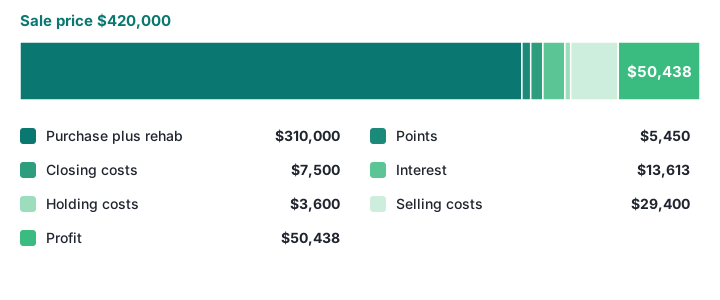
Where the $420,000 sale goes on a six-month flip: 2 points, $7,500 closing costs, 11% interest on drawn funds, $600 a month in holding costs and 7% selling costs.
That's a profit of about $50,400 on roughly $67,700 of cash in. Now run it three months long: more interest, more holding costs and a 1% extension fee take about $12,000 off the profit, leaving roughly $38,400. Timeline discipline is worth real money.
Five mistakes that cost flippers the most
- Budgeting the rehab without a contingency; 10 to 15% is common.
- Taking the ARV from the best comp instead of the most similar ones.
- Forgetting carrying costs and the time it takes to sell.
- Not knowing the extension terms before you need them.
- Starting work before you understand the draw process.
Decide to keep the house instead? A cash-out refinance can turn the flip into a long-term rental.
Frequently asked questions
How much can I borrow on a fix and flip loan?
It depends on the lender's structure and your experience. A common approach funds 80 to 90% of the purchase price and up to 100% of the rehab, capped at 65 to 75% of the after-repair value. Treat those ranges as typical, not guaranteed.
What is ARV in real estate lending?
After-repair value is what the property should be worth once the planned work is done, based on comparable sales. Lenders use it to cap the total loan.
How do rehab draws work?
You complete a phase of work, request a draw, an inspector confirms it, and the lender releases the funds. You usually front each phase before it's reimbursed.
What is the difference between Dutch and non-Dutch interest?
With non-Dutch interest you pay only on funds actually drawn. With Dutch interest you pay on the full loan amount from day one, including rehab money you haven't drawn yet.
How long do fix and flip loans last?
Terms commonly run 6 to 18 months, interest-only, often with paid extension options. Know the extension terms before you need them.
Get KREC insights first in Google Search.
Add KREC as a preferred source on GoogleRelated Articles
Hard money loans offer fast, flexible financing for real estate investors. Learn how they work, when to use them, and what to expect.
Everything you need to know about fix and flip financing, from loan terms to maximizing your profits on renovation projects.
How DSCR loans qualify a rental on its rent instead of your income: the formula, a worked example, what lenders check and a five-minute self-test.
Ready to Apply What You've Learned?
Get pre-approved for your next investment property. Fast closings, flexible terms.
Get Started Today